- by foxnews
- 15 May 2026
New AI brain lets robots move like humans
Genesis AI unveils GENE-26.5, a robotic brain it says enables general-purpose robots to perform complex physical tasks with human-level dexterity.
- by foxnews
- 07 May 2026
- in technology
Sign up for my FREE CyberGuy Report
Theo Gervet, co-founder and president of Genesis AI, says the easiest way to understand GENE-26.5 is to think of it as the system guiding the robot's actions.
"Think of GENE-26.5 like a robotic brain that takes in information and tells the robot what to do," Gervet said. "It is the industry's most advanced robotic brain, with the most advanced capabilities. We've proven this by releasing a few videos showing GENE-26.5 powering the most complex tasks ever performed by robots."
He says that matters because most robots still struggle with detailed hand movements. They often repeat one task in a controlled setting, but real life is less predictable.
"We've developed a way to feed GENE-26.5 massive amounts of data about how human hands move, so it can tell our robotic hands exactly how to move like a human's hands," Gervet said. "GENE-26.5 can also tell our robotic hands how to do tasks with many, many steps."
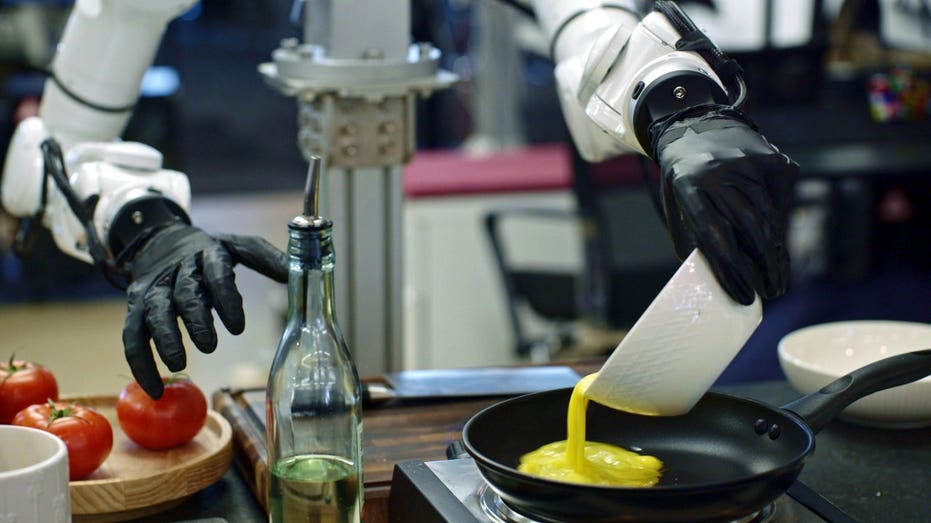
He pointed to a cooking example to show the difference. "For example, powered by GENE-26.5, our robotic hands can follow a 20-step process to make a full omelet from start to finish," Gervet said.
"That's why we're obsessed with innovating across the full-stack, from AI to hardware. By controlling every layer, we can build a cohesive system and solve the problem holistically. Our approach gives us a huge competitive advantage by harnessing unprecedented amounts of data, as that ultimately defines what foundation models can achieve."
He said people make small adjustments without noticing. "You may not even realize it, but your brain is taking notice of how the cube feels. Even if you're just holding the cube, your hands are never perfectly still."
Those small movements are constant. "They're constantly making micro adjustments to make sure the cube doesn't slip and stays balanced," he said. "It takes a lot of complicated, intentional and coordinated movements that involve over 20 joints in your fingers, knuckles and wrists. Our robotic hands can do exactly that."
He explained how the system captures detail. "When a human wears the gloves as they interact with objects or do their work, we can capture details about the exact movements their fingers and wrists make. Our robotic hands are built to exactly match a human's hands, so that data works extremely well."
Genesis AI says the glove is 100 times cheaper than typical options. It has also shown up to five times greater data collection efficiency compared with traditional methods.
Robots did not have that advantage. "The big problem comes from the fact that unless the robot's hand exactly matches a human's hand, any information you capture about how human hands move won't translate well," Gervet said.
He said matching the human hand solves that gap. "We've solved this problem by creating a robotic hand that exactly matches a human hand."
Genesis AI also uses other sources of data to train its system. "In addition to data from the glove, we use videos from humans wearing camera headbands so we can see how their hands move," Gervet said. "We also use massive amounts of internet videos."
The company says its simulation system is a major accelerator, allowing AI to train itself in a fully virtual environment before moving into the real world. This helps teams test and improve systems much faster than traditional physical testing, which can be slow and expensive.
He described a phased rollout. "To start, it can be deployed for industrial use in warehouses and for manufacturing logistics. We're already having conversations with industrial customers."
Gervet says safety testing is a core part of development. "Our technology goes through extensive testing and validation, first in simulation running millions of scenarios, then in controlled real-world environments," he said. "It has to earn its way into the room."
He went on to say the company is currently showcasing individual components, including the robotic brain, robotic hands and data collection system and plans to unveil a full general-purpose robot that brings everything together. Early, small-scale deployments with select partners could begin later this year.
Over time, that could change. Robots that can use the same tools as people may fit into existing spaces more easily, without needing everything redesigned around them.
"The beauty of the technology is that it's meant to fit seamlessly into the human world," Gervet said. "Humans will still lead, but our reach won't be limited by what we can do with our own hands."
Take my quiz: How safe is your online security?
Think your devices and data are truly protected? Take this quick quiz to see where your digital habits stand. From passwords to Wi-Fi settings, you'll get a personalized breakdown of what you're doing right and what needs improvement. Take my Quiz here: Cyberguy.com.
As robots move and handle objects more like humans, do you want one helping you at home, or would that feel like a step too far at this point? Let us know by writing to us at CyberGuy.com.
Sign up for my FREE CyberGuy Report
Copyright 2026 CyberGuy.com. All rights reserved.
you may also like

- by foxnews
- 15 May 2026
Fox News AI Newsletter: Graduation speaker praises AI, gets instantly booed

- by foxnews
- 14 May 2026
Apple's $250M Siri settlement: Are you owed cash?




travel
- by foxnews
- descember 09, 2016
Casino resorts in Nevada location, once packed, become ghost town as closure nears
Primm, Nevada, could become the first "gambling ghost town" as its last casino hotel is scheduled to shut down on July 4, ending decades of border town gaming.
read more